Ludwig van Beethoven
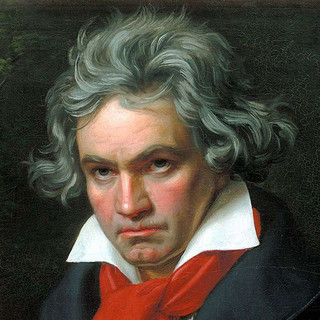
Ludwig van Beethoven (baptised 17 December 1770 – 26 March 1827) was a German composer, conductor, and pianist. Mentored during the Classical period, Beethoven's musical style was a key driver of the transition to Romantic music, and the expansion of popular forms such as the symphony and string quartet. His compositions have attracted casual and scholarly interest, and remain among the most performed in the world.
Born in Bonn, Beethoven was a musical prodigy. He was initially taught intensively by his father, Johann van Beethoven, and later by Christian Gottlob Neefe. He found relief from a dysfunctional home life with the family of Helene von Breuning, whose children he loved, befriended, and taught piano. At age 21, he moved to Vienna, which subsequently became his base, and studied composition with Joseph Haydn. Beethoven gained a reputation as a virtuoso pianist, and was soon patronized by Karl Alois, Prince Lichnowsky for compositions, which resulted in his three Piano Trios, Op. 1, (the earliest works to which he accorded an opus number) in 1795. His Pathétique Sonata was composed in 1798. Around this time, Beethoven began experiencing symptoms of hearing loss.
His career is divided into three periods. In the first, he composed in the classical style of Haydn and Wolfgang Amadeus Mozart. Beethoven's First Symphony premiered in 1800, and his first set of string quartets was published in 1801. The Moonlight Sonata, dedicated to his pupil Julie Guicciardi, is one of his most popular works. In the middle period (1802–1812), he developed a distinctive style. His Third (Eroica) and Fifth Symphonies premiered in 1805 and 1808, respectively. The former was unprecedented in scale and scope. His opera, Fidelio, premiered in 1805, and was later revised. His Violin Concerto appeared in 1806. His Razumovsky quartets were published in 1808. Other middle works include the Waldstein and Appassionata sonatas for piano, the Kreutzer sonata for violin and his Seventh Symphony. His Emperor piano concerto premiered in 1811, without the composer as soloist.
His late period (1812–1827) included some of his most innovative works. His Missa solemnis and his final symphony, the Ninth, premiered in 1824. The latter was the first major example of a choral symphony. His Diabelli Variations and late piano sonatas, particularly the Hammerklavier, are summits of the keyboard literature. His late string quartets, including the Große Fuge, of 1825–1826, are considered pinnacles of the genre. After several months of illness, which left him bedridden, Beethoven died on 26 March 1827 at the age of 56.
Spring Adagios
- 2026-06-04T00:00:00.000000Z
Peaceful Cello
- 2026-06-04T00:00:00.000000Z
Grande Dame
- 2026-06-03T00:00:00.000000Z
-
Offenbach: La Grande-duchesse de Gérolstein, Act 1: Air et chœur. "Ah ! Que j'aime les militaires" (Duchesse, Fritz, Puck, Boum, Chœur) - Grande Dame -
Ludwig van Beethoven
-
Offenbach: La Grande-duchesse de Gérolstein, Act 1: Final. "Voici le sabre de mon père" (Chœur, Duchesse, Boum, Fritz, Wanda, Puck Népomuc, Paul) - Grande Dame -
Ludwig van Beethoven
-
Offenbach: La Grande-duchesse de Gérolstein, Act 2: Duetto. "Dites lui qu'on l'a remarqué" (Duchesse, Fritz) - Grande Dame -
Ludwig van Beethoven
-
Purcell: Come Ye Sons of Art, Z. 323 "Ode for Queen Mary's Birthday": No. 7, Aria. "Bid the Virtues" - Grande Dame -
Ludwig van Beethoven
-
Purcell: Come Ye Sons of Art, Z. 323 "Ode for Queen Mary's Birthday": No. 9, Duet and Chorus. "See Nature Rejoicing" - Grande Dame -
Ludwig van Beethoven
-
Vaughan Williams: Symphony No. 1 "A Sea Symphony": IV. (e) The Explorers. "Greater Than Stars or Suns" - Grande Dame -
Ludwig van Beethoven
-
Vaughan Williams: Symphony No. 1 "A Sea Symphony": IV. (f) The Explorers. "Sail Forth" - Grande Dame -
Ludwig van Beethoven
-
Vaughan Williams: Symphony No. 1 "A Sea Symphony": IV. (g) The Explorers. "O My Brave Soul" - Grande Dame -
Ludwig van Beethoven
-
Charpentier: Magnificat, H. 74: Quia fecit mihi magna - Grande Dame -
Ludwig van Beethoven
-
Charpentier: Magnificat, H. 74: Suscepit Israel - Grande Dame -
Ludwig van Beethoven
-
Ravel: Noël des jouets, M. 47 - Grande Dame -
Ludwig van Beethoven
-
Mozart: Le nozze di Figaro, K. 492, Act 2: Cavatina. "Porgi, amor" (Contessa) - Grande Dame -
Ludwig van Beethoven
-
Mozart: Le nozze di Figaro, K. 492, Act 2: Terzetto. "Susanna, or via, sortite" (Conte, Contessa, Susanna) - Grande Dame -
Ludwig van Beethoven
-
Mozart: Le nozze di Figaro, K. 492, Act 3: Aria. "Dove sono i bei momenti" (Contessa) - Grande Dame -
Ludwig van Beethoven
-
Mozart: Le nozze di Figaro, K. 492, Act 3: "Sull'aria... Che soave zeffiretto" (Contessa, Susanna) - Grande Dame -
Ludwig van Beethoven
-
Beethoven: 12 Irish Songs, WoO154: No. 1, The Elfin Fairies - Grande Dame -
Ludwig van Beethoven
-
Beethoven: 12 Irish Songs, WoO154: No. 9, Oh! Would I Were But That Sweet Linnet - Grande Dame -
Ludwig van Beethoven
-
Lehár: The Merry Widow, Act 1: Entrance Song. "Bitte, meine Herr'n" (Hanna, Cascada, Saint-Brioche, Chorus) [Live at Royal Festival Hall, 1993] - Grande Dame -
Ludwig van Beethoven
-
Lehár: The Merry Widow, Act 2: Introduction and Dance. "Ich bitte, hier jetzt zu verweilen" - Vilja Song. "Es lebt eine Vilja" (Hanna, Chorus) [Live at Royal Festival Hall, 1993] - Grande Dame -
Ludwig van Beethoven
-
Lehár: The Merry Widow, Act 2: The Stupid Rider Song. "Heia, Mädel, aufgeschaut" (Hanna, Danilo) [Live at Royal Festival Hall, 1993] - Grande Dame -
Ludwig van Beethoven
-
Lehár: The Merry Widow, Act 3: Duet. "Lippen schweigen" (Hanna, Danilo) [Live at Royal Festival Hall, 1993] - Grande Dame -
Ludwig van Beethoven
-
Ravel: 3 Poèmes de Stéphane Mallarmé, M. 64: No. 1, Soupir - Grande Dame -
Ludwig van Beethoven
-
Ravel: 3 Poèmes de Stéphane Mallarmé, M. 64: No. 2, Placet futile - Grande Dame -
Ludwig van Beethoven
-
Ravel: 3 Poèmes de Stéphane Mallarmé, M. 64: No. 3, Surgi de la croupe et du bond - Grande Dame -
Ludwig van Beethoven
-
Schumann: Liederalbum für die Jugend, Op. 79: No. 19, Frühlingslied - Grande Dame -
Ludwig van Beethoven
-
Brahms: 4 Duets, Op. 61: No. 1, Die Schwestern - Grande Dame -
Ludwig van Beethoven
-
Mendelssohn: 6 Gesänge, Op. 19a: No. 4, Neue Liebe, MWV K70 - Grande Dame -
Ludwig van Beethoven
-
Delage: 4 Poèmes hindous: No. 1, Madras - Grande Dame -
Ludwig van Beethoven
-
Delage: 4 Poèmes hindous: No. 2, Lahore - Grande Dame -
Ludwig van Beethoven
-
Delage: 4 Poèmes hindous: No. 3, Bénarès. Naissance de Bouddha - Grande Dame -
Ludwig van Beethoven
-
Delage: 4 Poèmes hindous: No. 4, Jaipur. Stance de Bhartrihari - Grande Dame -
Ludwig van Beethoven
-
Britten: Purcell Realizations: 6 Duets from Orpheus Britannicus: No. 1, Sound the Trumpet - Grande Dame -
Ludwig van Beethoven
-
Britten: Purcell Realizations: 7 Songs from Orpheus Britannicus: No. 1, Fairest Isle - Grande Dame -
Ludwig van Beethoven
-
Charpentier, G: Louise, Act 3: "Depuis le jour où je me suis donnée" (Louise, Julien) - Grande Dame -
Ludwig van Beethoven
-
Charpentier, G: Louise, Act 3: "Louise est heureuse ?" (Louise, Julien) - Grande Dame -
Ludwig van Beethoven
-
Charpentier, G: Louise, Act 3: "Tout être a le droit d'être libre" (Louise, Julien) - Grande Dame -
Ludwig van Beethoven
-
Charpentier, G: Louise, Act 3: "Julien !" (Louise, Julien, Chœur) - Grande Dame -
Ludwig van Beethoven
-
Charpentier, G: Louise, Act 3: "Ah ! Prends-moi vite" (Louise, Julien) - Grande Dame -
Ludwig van Beethoven
-
Delibes: Les trois oiseaux - Grande Dame -
Ludwig van Beethoven
-
Massenet: Trois mélodies, deux duos et un trio, Op. 2: No. 5, Joie ! - Grande Dame -
Ludwig van Beethoven
-
Paladilhe: Au bord de l'eau - Grande Dame -
Ludwig van Beethoven
-
Aubert: Cache-cache - Grande Dame -
Ludwig van Beethoven
-
Mozart / Compl. Beyer: Requiem in D Minor, K. 626: I. Introitus - Grande Dame -
Ludwig van Beethoven
-
Mozart / Compl. Beyer: Requiem in D Minor, K. 626: VI. Recordare - Grande Dame -
Ludwig van Beethoven
-
Messager: L'amour masqué, Act 1: "J'ai deux amants" (Elle) - Grande Dame -
Ludwig van Beethoven
-
Straus: Les trois valses, Act 2: "Je t'aime quand même" (Yvette) - Grande Dame -
Ludwig van Beethoven
-
Offenbach: La Périchole, Act 1: "Tu n'es pas riche, tu n'es pas beau" (La Périchole) - Grande Dame -
Ludwig van Beethoven
-
Handel: Samson, HWV 57, Act 3: Aria. "Let the Bright Seraphim" (Israelite Woman) - Grande Dame -
Ludwig van Beethoven
-
Balfe: Trust her Not - Grande Dame -
Ludwig van Beethoven
-
Sullivan: Coming Home - Grande Dame -
Ludwig van Beethoven
Similar Artists