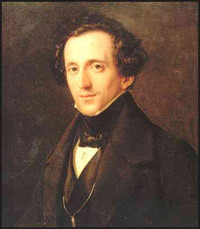
Felix Mendelssohn
Jakob Ludwig Felix Mendelssohn Bartholdy (3 February 1809 – 4 November 1847), simply known as Felix Mendelssohn, was a German composer, pianist, organist and conductor of the early Romantic era. Mendelssohn's compositions include symphonies, concertos, piano music, organ music and chamber music. His best-known works include the String Octet, the overture and incidental music for A Midsummer Night's Dream (which includes his "Wedding March"), the Italian and Scottish Symphonies, the oratorios St. Paul and Elijah, the Hebrides Overture, the mature Violin Concerto, and the melody used in the Christmas carol "Hark! The Herald Angels Sing". Mendelssohn's Songs Without Words are his most famous solo piano compositions.
Mendelssohn's grandfather was the Jewish philosopher Moses Mendelssohn, but Felix was initially raised without religion until he was baptised aged seven into the Reformed Christian church. He was recognised early as a musical prodigy, but his parents were cautious and did not seek to capitalise on his talent. His sister Fanny received a similar musical education and was a talented composer and pianist in her own right; some of her early songs were published under her brother's name and her Easter Sonata was for a time mistakenly attributed to him after being lost and rediscovered in the 1970s.
Mendelssohn enjoyed early success in Germany, and revived interest in the music of Johann Sebastian Bach, notably with his performance of the St Matthew Passion in 1829. He became well received in his travels throughout Europe as a composer, conductor and soloist; his ten visits to Britain – during which many of his major works were premiered – form an important part of his adult career. His essentially conservative musical tastes set him apart from more adventurous musical contemporaries, such as Franz Liszt, Richard Wagner, Charles-Valentin Alkan and Hector Berlioz. The Leipzig Conservatory, which he founded, became a bastion of this anti-radical outlook.
After a long period of relative denigration due to changing musical tastes and antisemitism in the late 19th and early 20th centuries, his creative originality has been re-evaluated. He is now among the most popular composers of the Romantic era.
Beyond Words
- 2026-06-05T00:00:00.000000Z
Spring Adagios
- 2026-06-04T00:00:00.000000Z
Peaceful Cello
- 2026-06-04T00:00:00.000000Z
Grande Dame
- 2026-06-03T00:00:00.000000Z
-
Offenbach: La Grande-duchesse de Gérolstein, Act 1: Air et chœur. "Ah ! Que j'aime les militaires" (Duchesse, Fritz, Puck, Boum, Chœur) - Grande Dame -
Felix Mendelssohn
-
Offenbach: La Grande-duchesse de Gérolstein, Act 1: Final. "Voici le sabre de mon père" (Chœur, Duchesse, Boum, Fritz, Wanda, Puck Népomuc, Paul) - Grande Dame -
Felix Mendelssohn
-
Offenbach: La Grande-duchesse de Gérolstein, Act 2: Duetto. "Dites lui qu'on l'a remarqué" (Duchesse, Fritz) - Grande Dame -
Felix Mendelssohn
-
Purcell: Come Ye Sons of Art, Z. 323 "Ode for Queen Mary's Birthday": No. 7, Aria. "Bid the Virtues" - Grande Dame -
Felix Mendelssohn
-
Purcell: Come Ye Sons of Art, Z. 323 "Ode for Queen Mary's Birthday": No. 9, Duet and Chorus. "See Nature Rejoicing" - Grande Dame -
Felix Mendelssohn
-
Vaughan Williams: Symphony No. 1 "A Sea Symphony": IV. (e) The Explorers. "Greater Than Stars or Suns" - Grande Dame -
Felix Mendelssohn
-
Vaughan Williams: Symphony No. 1 "A Sea Symphony": IV. (f) The Explorers. "Sail Forth" - Grande Dame -
Felix Mendelssohn
-
Vaughan Williams: Symphony No. 1 "A Sea Symphony": IV. (g) The Explorers. "O My Brave Soul" - Grande Dame -
Felix Mendelssohn
-
Charpentier: Magnificat, H. 74: Quia fecit mihi magna - Grande Dame -
Felix Mendelssohn
-
Charpentier: Magnificat, H. 74: Suscepit Israel - Grande Dame -
Felix Mendelssohn
-
Ravel: Noël des jouets, M. 47 - Grande Dame -
Felix Mendelssohn
-
Mozart: Le nozze di Figaro, K. 492, Act 2: Cavatina. "Porgi, amor" (Contessa) - Grande Dame -
Felix Mendelssohn
-
Mozart: Le nozze di Figaro, K. 492, Act 2: Terzetto. "Susanna, or via, sortite" (Conte, Contessa, Susanna) - Grande Dame -
Felix Mendelssohn
-
Mozart: Le nozze di Figaro, K. 492, Act 3: Aria. "Dove sono i bei momenti" (Contessa) - Grande Dame -
Felix Mendelssohn
-
Mozart: Le nozze di Figaro, K. 492, Act 3: "Sull'aria... Che soave zeffiretto" (Contessa, Susanna) - Grande Dame -
Felix Mendelssohn
-
Beethoven: 12 Irish Songs, WoO154: No. 1, The Elfin Fairies - Grande Dame -
Felix Mendelssohn
-
Beethoven: 12 Irish Songs, WoO154: No. 9, Oh! Would I Were But That Sweet Linnet - Grande Dame -
Felix Mendelssohn
-
Lehár: The Merry Widow, Act 1: Entrance Song. "Bitte, meine Herr'n" (Hanna, Cascada, Saint-Brioche, Chorus) [Live at Royal Festival Hall, 1993] - Grande Dame -
Felix Mendelssohn
-
Lehár: The Merry Widow, Act 2: Introduction and Dance. "Ich bitte, hier jetzt zu verweilen" - Vilja Song. "Es lebt eine Vilja" (Hanna, Chorus) [Live at Royal Festival Hall, 1993] - Grande Dame -
Felix Mendelssohn
-
Lehár: The Merry Widow, Act 2: The Stupid Rider Song. "Heia, Mädel, aufgeschaut" (Hanna, Danilo) [Live at Royal Festival Hall, 1993] - Grande Dame -
Felix Mendelssohn
-
Lehár: The Merry Widow, Act 3: Duet. "Lippen schweigen" (Hanna, Danilo) [Live at Royal Festival Hall, 1993] - Grande Dame -
Felix Mendelssohn
-
Ravel: 3 Poèmes de Stéphane Mallarmé, M. 64: No. 1, Soupir - Grande Dame -
Felix Mendelssohn
-
Ravel: 3 Poèmes de Stéphane Mallarmé, M. 64: No. 2, Placet futile - Grande Dame -
Felix Mendelssohn
-
Ravel: 3 Poèmes de Stéphane Mallarmé, M. 64: No. 3, Surgi de la croupe et du bond - Grande Dame -
Felix Mendelssohn
-
Schumann: Liederalbum für die Jugend, Op. 79: No. 19, Frühlingslied - Grande Dame -
Felix Mendelssohn
-
Brahms: 4 Duets, Op. 61: No. 1, Die Schwestern - Grande Dame -
Felix Mendelssohn
-
Mendelssohn: 6 Gesänge, Op. 19a: No. 4, Neue Liebe, MWV K70 - Grande Dame -
Felix Mendelssohn
-
Delage: 4 Poèmes hindous: No. 1, Madras - Grande Dame -
Felix Mendelssohn
-
Delage: 4 Poèmes hindous: No. 2, Lahore - Grande Dame -
Felix Mendelssohn
-
Delage: 4 Poèmes hindous: No. 3, Bénarès. Naissance de Bouddha - Grande Dame -
Felix Mendelssohn
-
Delage: 4 Poèmes hindous: No. 4, Jaipur. Stance de Bhartrihari - Grande Dame -
Felix Mendelssohn
-
Britten: Purcell Realizations: 6 Duets from Orpheus Britannicus: No. 1, Sound the Trumpet - Grande Dame -
Felix Mendelssohn
-
Britten: Purcell Realizations: 7 Songs from Orpheus Britannicus: No. 1, Fairest Isle - Grande Dame -
Felix Mendelssohn
-
Charpentier, G: Louise, Act 3: "Depuis le jour où je me suis donnée" (Louise, Julien) - Grande Dame -
Felix Mendelssohn
-
Charpentier, G: Louise, Act 3: "Louise est heureuse ?" (Louise, Julien) - Grande Dame -
Felix Mendelssohn
-
Charpentier, G: Louise, Act 3: "Tout être a le droit d'être libre" (Louise, Julien) - Grande Dame -
Felix Mendelssohn
-
Charpentier, G: Louise, Act 3: "Julien !" (Louise, Julien, Chœur) - Grande Dame -
Felix Mendelssohn
-
Charpentier, G: Louise, Act 3: "Ah ! Prends-moi vite" (Louise, Julien) - Grande Dame -
Felix Mendelssohn
-
Delibes: Les trois oiseaux - Grande Dame -
Felix Mendelssohn
-
Massenet: Trois mélodies, deux duos et un trio, Op. 2: No. 5, Joie ! - Grande Dame -
Felix Mendelssohn
-
Paladilhe: Au bord de l'eau - Grande Dame -
Felix Mendelssohn
-
Aubert: Cache-cache - Grande Dame -
Felix Mendelssohn
-
Mozart / Compl. Beyer: Requiem in D Minor, K. 626: I. Introitus - Grande Dame -
Felix Mendelssohn
-
Mozart / Compl. Beyer: Requiem in D Minor, K. 626: VI. Recordare - Grande Dame -
Felix Mendelssohn
-
Messager: L'amour masqué, Act 1: "J'ai deux amants" (Elle) - Grande Dame -
Felix Mendelssohn
-
Straus: Les trois valses, Act 2: "Je t'aime quand même" (Yvette) - Grande Dame -
Felix Mendelssohn
-
Offenbach: La Périchole, Act 1: "Tu n'es pas riche, tu n'es pas beau" (La Périchole) - Grande Dame -
Felix Mendelssohn
-
Handel: Samson, HWV 57, Act 3: Aria. "Let the Bright Seraphim" (Israelite Woman) - Grande Dame -
Felix Mendelssohn
-
Balfe: Trust her Not - Grande Dame -
Felix Mendelssohn
-
Sullivan: Coming Home - Grande Dame -
Felix Mendelssohn
Similar Artists